
The Differences Between Laparoscopic Surgery vs Open Surgery: Benefits and Recovery
If surgery is suggested, patients may have concerns about the procedure, recovery time, pain, and potential risks. A common one is whether it's better to have laparoscopic surgery or open surgery.
Both techniques are used to relieve many medical conditions. But there are differences between laparoscopic surgery vs open surgery in the size of the incision, instruments employed, recovery program, and scenarios where either type might be recommended. Knowing the differences is important so the patient is able to better inform their surgeon on their discussion.
Patients at Matoshree Multispeciality Hospital, Kamothe, can consult the doctors about surgical options available and the way they may be suitable for the patient's condition.
What is Laparoscopic Surgery?
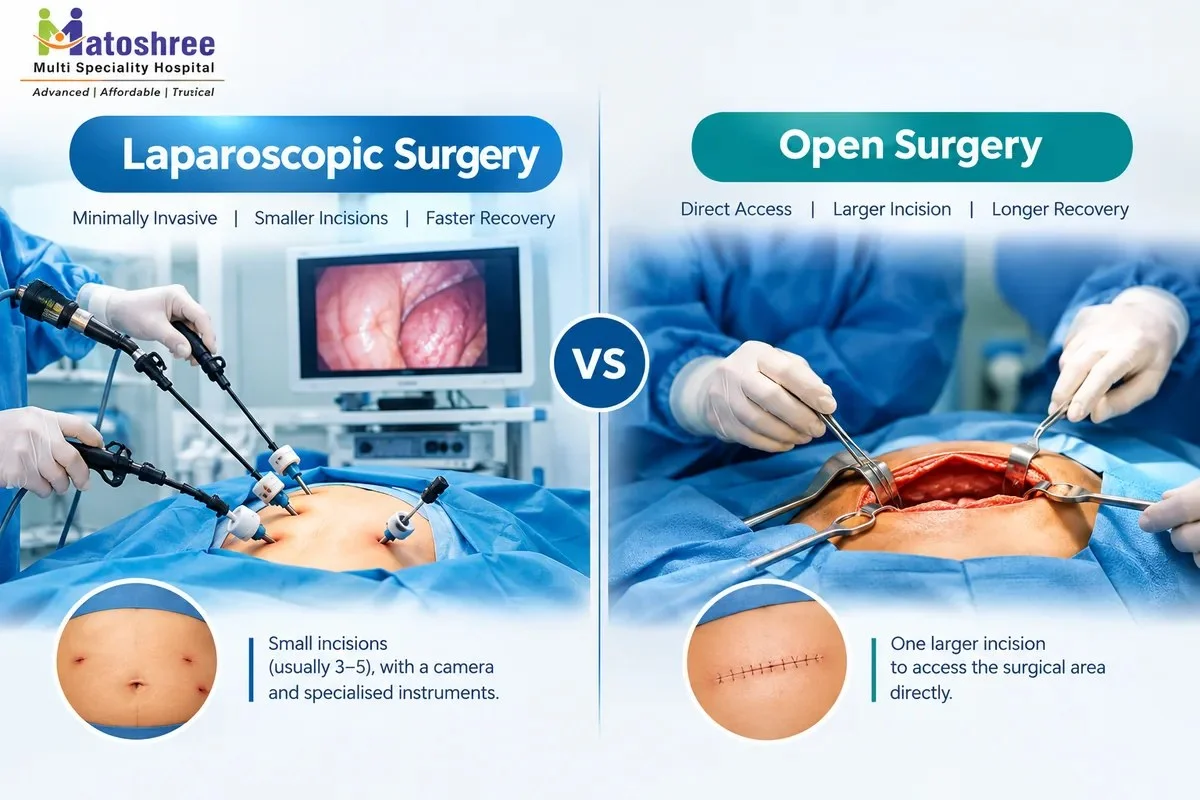
Laparoscopic surgery is a minimally invasive surgery, also referred to as a 'keyhole' surgery. The surgeon does not have to make one large cut; rather, several small incisions are made into which a thin instrument equipped with a camera (laparoscope) and various surgical instruments can be introduced.
The camera projects pictures of the inside area on a screen that allows the surgeon to work with the pictures.
Some surgeries, such as gallbladder removal, hernia repair, and some gynaecology surgeries, may use laparoscopic techniques. This method is applicable to patients diagnosed with certain diseases, with a certain medical history, and depending on the complexity of surgery.
The advantages of Laparoscopic surgery are many. Laparoscopic surgery has numerous benefits.
If appropriate to the condition, there can be a number of benefits to laparoscopic surgery:
- Less surgical opening size: The surgical openings are typically smaller as compared to traditional open surgery.
- Less postoperative pain: Less pain is felt by many patients after surgery, but this might not apply to everyone based on the type of surgery and the patient themselves.
- Small scarring: Small incisions mean small scarring.
- Faster recovery: Some patients recover faster when compared to other open surgeries.
- Shorter hospital stay: Based on the operation and the recovery process, some patients spend less time in the hospital.
These are not guaranteed to all patients. It depends on the patient and the type of surgery he/she had.
What is Open Surgery?
Open surgery is an old-fashioned method of surgery where the surgeon cuts a large incision into the skin to expose the affected organ or tissue. This will give the surgeon direct access to the surgical area, and the surgeon will be able to use the traditional surgical instruments.
Open surgery is still an integral part of today's health care. It may be recommended in complicated disease situations, extensive disease, some emergencies, or when a minimally invasive approach is not appropriate.
When may Open Surgery be Recommended?
Open surgery may be an option if:
- Access should be increased to the affected area for the condition.
- Major repairs or reconstruction is required.
- So far, there is a lot of internal scar tissue.
- Severe bleeding or an emergency arises that requires management.
- Laparoscopic surgery is not safe and/or has inadequate access.
The decision for open surgery does not imply a less sophisticated treatment. The aim is to choose the most suitable and safe treatment for the particular patient.
The differences between laparoscopic surgery and open surgery are highlighted.
Laparoscopic surgery and open surgery differ in the way the surgeon reaches the area to be operated upon. Other variations can encompass postoperative pain, scarring, time spent in the hospital, and recuperation.
| Comparison factor | Laparoscopic surgery | Open surgery |
|---|---|---|
| Incision size | Usually several small incisions | Usually one larger incision |
| Surgical access | Camera and specialised instruments | Direct access to the surgical area |
| Post-operative pain | Often less for comparable procedures | May involve more incision-related discomfort |
| Scarring | Generally smaller scars | Generally a larger scar |
| Recovery | May allow an earlier return to routine activities | May require a longer recovery period |
| Hospital stay | May be shorter, depending on the procedure | May be longer, depending on the procedure |
| Suitability | Appropriate for selected conditions | Important for complex cases and certain emergencies |
The above comparison is only a general comparison and is not a representation of a guaranteed outcome. The recovery requirements vary among different procedures, and some laparoscopic procedures may be more complex than others.
Which Surgery is Better, Laparoscopic or Open?
In the right patient laparoscopic surgery can have advantages in terms of size of incision, postoperative pain and recovery. But this kind of surgery may not always be the best course of action for every condition.
In some cases, open surgery may be the better choice for the patient if the physician needs more access or the patient’s condition is more complex.
The solution will differ based on variables such as:
- The nature and severity of the medical condition.
- Site of disease or injury
- Previous abdominal or pelvic surgery.
- The patient’s age, overall health and other medical conditions.
- The surgeon’s view of the risks and benefits of each option.
Patients who are thinking about undergoing treatment can ask a laparoscopic surgeon in Kamothe about their diagnosis, the procedure, and their recovery.
Recovery After Laparoscopic and Open Surgery
Considering the recovery time is crucial when comparing laparoscopic surgery vs open surgery. There's no single recovery time that's true of all operations, however.
Recovery after Laparoscopic Surgery.
Many patients who have a “straightforward” lap procedure will have a relatively brief recovery. Depending on the operation performed and the surgeon's guidance, they might be able to return to light activities earlier.
Patients should adhere to the recommendations given for their discharge, keep the incisions clean and dry as directed, attend the follow-up appointments, and refrain from heavy work until the doctor says it's safe.
Soreness, bloating, or shoulder discomfort may follow some of the laparoscopic surgeries. If symptoms are persistent or severe, or if they get worse, patients should seek medical attention.
Recovery following Open Surgery.
The larger incision and surrounding tissue may take longer to heal if performed by open surgery. Patients may require extended hospitalisation, assistance with daily activities and a gradual return to work/exercise.
Treatment for recovery may include pain medication, wound care, diet and periodic check-ups. Patients should refrain from lifting heavy objects or doing vigorous exercise until their surgeon has approved it.
In either method, recovery is dependent on the kind of procedure done, the health of the patient, and the presence of complications.
Risks of Laparoscopic Surgery vs Open Surgery
As with any surgery, either laparoscopic or open, there is the possibility of complications. Some of these can be bleeding, infection, anaesthetic reaction, blood clots, and damage to surrounding structures.
There are also risks in laparoscopic surgery, including using gas to provide sufficient space in the abdomen and the use of instruments to gain access. In a few cases, surgery will have to be performed using open surgery instead of laparoscopy due to its safety.
An open surgery might result in more wound pain or problems caused by a bigger cut.
The likelihood of complications varies according to the procedure, the patient's medical history, and other individual factors. A surgeon will be able to discuss the risks that are applicable to an individual's specific case.
Selecting the appropriate surgical technique. Opting for the best surgical technique.
Before recommending a procedure, a surgeon evaluates the diagnosis, the extent of the condition, investigation results, and the patient's general health. The surgeon will next think about whether a laparoscopic or open surgery will be the best kind of treatment.
To help prepare for a consultation, patients should ask:
- Does my condition make laparoscopic surgery a good option?
- What are the advantages/disadvantages of each strategy for me?
- What period of time will I be in hospital for?
- When will I be able to work and do things again?
- Is there a possibility that the operation may need to be converted to open surgery?
- What is my aftercare?
To know more about the procedure, read our guide on laparoscopy.
Laparoscopic Surgery Consultation in Kamothe, Navi Mumbai
Patients should be informed of the differences between laparoscopic surgery vs open surgery to help them feel more prepared when consulting with a surgeon. In some conditions, laparoscopy may be able to be performed with smaller incisions, possibly resulting in a quicker recovery, but in many complex conditions, laparoscopy is not an option, and open surgery is indicated.
Patients may approach Matoshree Multispeciality Hospital to get medical advice on surgical options, the surgical procedure involved, post-surgical care, etc. Treatment should always involve an individual clinical assessment to determine the most appropriate treatment plan.
Visit the Matoshree Multispeciality Hospital website for more information about the hospital's services and departments.
This article is provided for educational purposes only and is not intended to be a substitute for professional medical advice, diagnosis or treatment. Talk with a surgeon about the type of surgery that is best for you.
Frequently Asked Questions
1. The primary difference between laparoscopy and laparotomy is:
For laparoscopic surgery, small incisions are made, and a camera and specialised instruments are used, while open surgery involves making a larger incision to gain direct access to the surgical site.
2. Is there a quicker recovery period with laparoscopic surgery?
It may be better to have a suitable laparoscopic procedure and recover more quickly due to the smaller incisions. Recovery will be contingent, though, on the nature of the surgery, the patient's overall health, and complications.
3. Is the laparoscopic surgery safer than open surgery?
Both methods are not necessarily safer. The safest choice will depend on the condition being treated, the complexity of the procedure, and other factors that will apply to each individual.
4. Does the laparoscopy procedure (surgery) have a risk of becoming open surgery?
Yes. If the surgeon deems the patient's safety to be at risk due to poor visibility, access or other factors, the surgeon will switch to open surgery. This is a well-established surgical choice.
5. What surgery am I in need of?
A surgeon with the appropriate expertise can evaluate your symptoms, investigations, medical history, and diagnosis before suggesting a proper strategy. Discuss the expected benefits, risks, and recovery requirements before making a decision.
Conclusion:
The decision between laparoscopic surgery and open surgery will vary depending on the medical condition, complexity of the surgery, and the surgeon's clinical judgement. For those who may be candidates, it may have advantages, including the relative ease of smaller incisions, less post-operative discomfort, and a potentially faster recovery. When wider surgical access is needed, however, open surgery is still an important choice to make.
There is no universal solution that is best for all. Patients can make informed decisions for their treatment by understanding the benefits, risks, and recovery expectations of each technique. In Kamothe or Navi Mumbai, if you are considering surgical treatment, speak to the surgeon to find out what treatment is suitable for your condition. For more information about the Laparoscopic surgeon services, please visit the Laparoscopic surgeon service page of.




















 (1).png)